Sample descriptions of some 16,300 Tasmanian place names
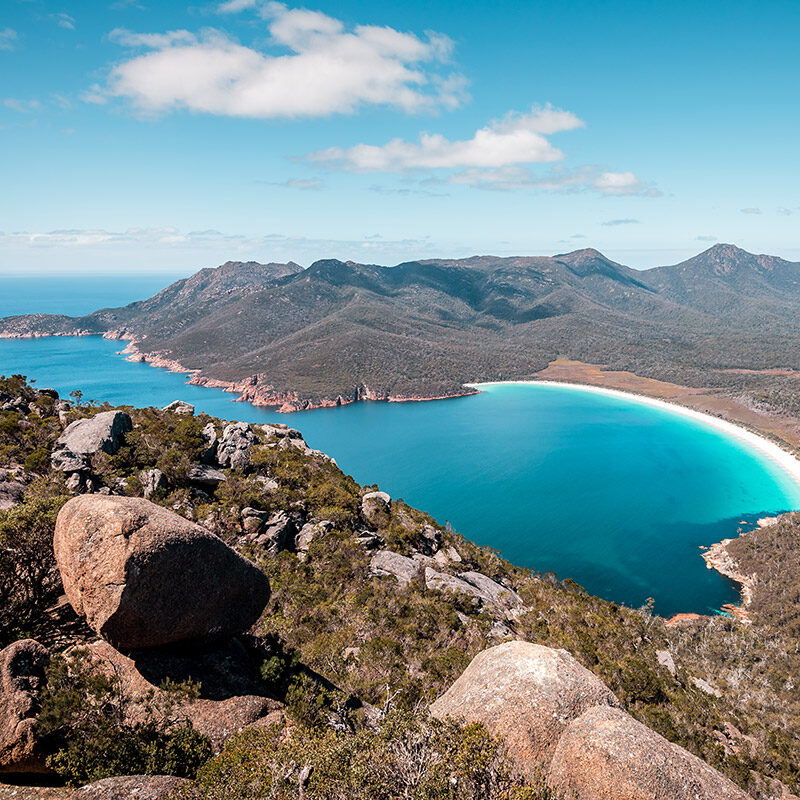
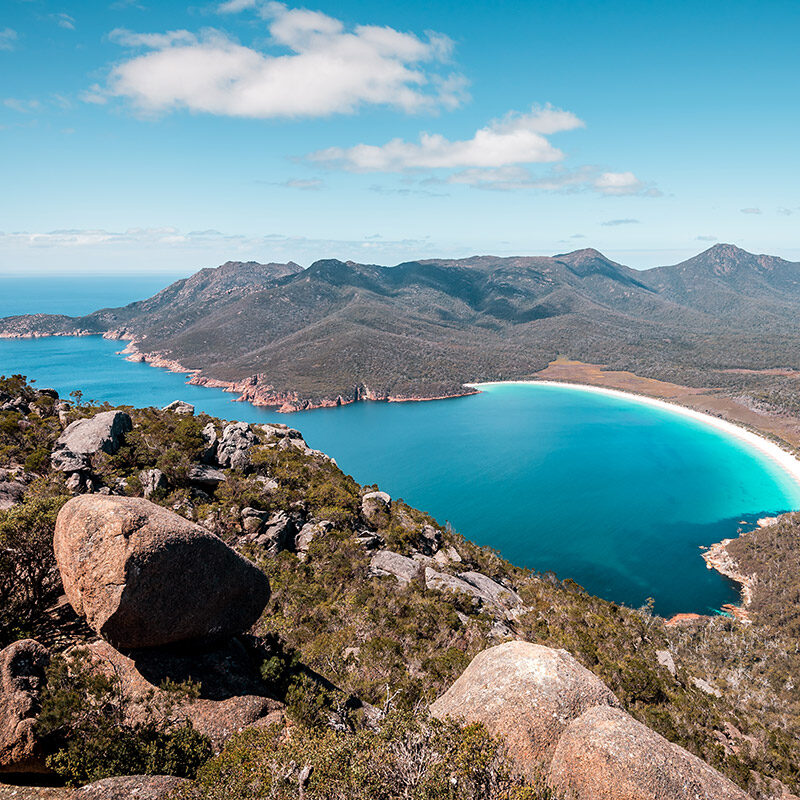
WINEGLASS BAY Originally this east-facing large bay was charted by Nicolas Thomas Baudin (1754-1803) in 1802, and he named the whole water body Bay Thouin to honour the chief botanist of the Paris Public Gardens, André Thouin (1727-1834). Wineglass Bay is a smaller land-hugging part of today’s Thouin Bay, resplendent with a 2-km-long, tourist-popular, curved white sand beach, and crashing surf. The average visitor assumes the name refers to its perfect curved wineglass shape. However the name was originally coined by whalers, in reference to the blood-coloured water resulting from whale processing (i.e. carving up the blubber…flensing) on the beach. In 1988 Queen Elisabeth II and the Duke of Edinburgh enjoyed a barbeque on this beach! Here, on 31st October, 1882, the 16-tonne ketch Guiding Star was forced ashore in a north-westerly gale and wrecked. No crew suffered. Also, on the night of 22nd October, 1916, the 1902-built 41-tonne fishing ketch Mary Burgess parted from her anchor, was blown ashore here and wrecked. No crew suffered. And, on 7th December, 1855, the 1948-built, 27-tonne cutter Struggler, on a voyage from Douglas River to Hobart Town with a cargo of coal, sprang a leak. The crew threw overboard most of the coal to reduce seawater intake, and she was finally beached here. She broke up on the beach and no crew suffered. Also, in February 1841, the 1830-built 47-ton schooner Tasmanian Lass was at anchor while the crew was ashore. An unexpected gale quickly drove her on the rocks and she sank. And here, at the beach’s south-east end, on 8th January, 1981, the 1933-built, 5-ton, 8.7-metre fishing vessel Wenona, under Skipper B.C. Schultz, was wrecked. All crew struggled to the beach. A tourist ‘must-see’.
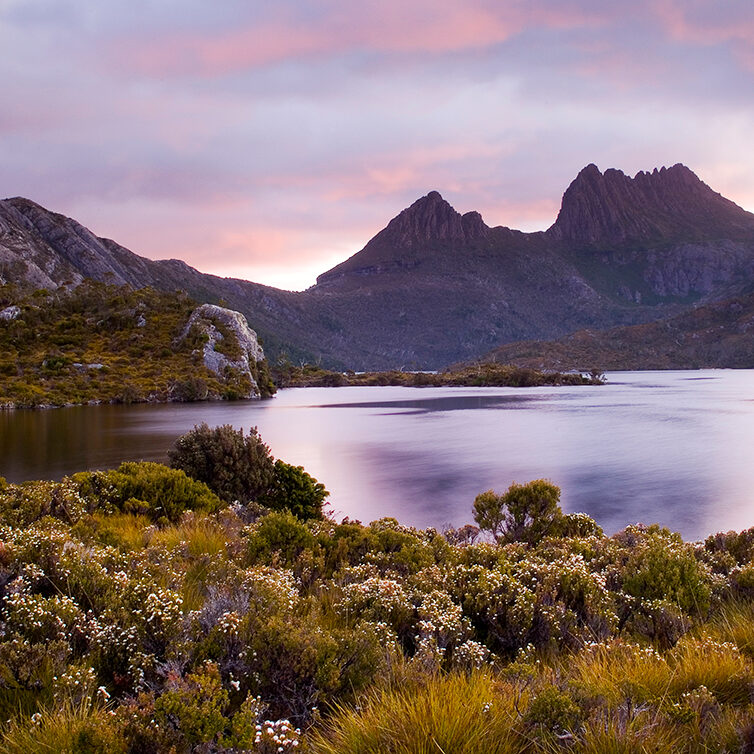
CRADLE MOUNTAIN 1,545-metres elevation. This rugged double peak was so-named in 1828 by the Van Diemen’s Land Company surveyor Joseph Fossey (1788-1851), due to the resemblance of a baby’s cradle to him. Romantic imaginings since have conjured the shape of a gold-miner’s gravel-washing cradle, but not so! Another Van Diemen’s Land Company surveyor, Henry Hellyer (1790-1832), was the first European to climb to its top in March, 1831. The original name was Rock Rib Crest, but prior to that Little Horn and Big Horn! In the summer holidays of 1890-1891, William Bubrelle Weston (1869-1948), at age 21, led the very first tourist walking group to the summit. He is buried in Carr Villa Cemetery, at Launceston city’s suburb Kings Meadows. The view across Lake Dove to this mountain is possible the most photographed in Tasmania. A ‘tourist must-see’.
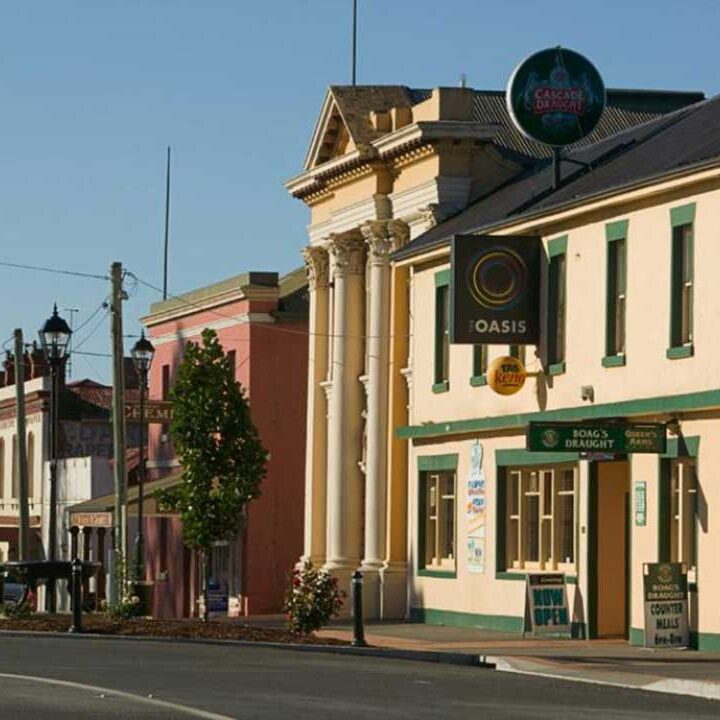
LONGFORD (town). 140-metres average elevation. First settled in 1813 and named by Governor George Arthur (1784-1854) in 1830, from the inn mentioned herein, the general area was first known as Norfolk Plains when pioneers from Norfolk Island were settled here, and then, in 1827, as La Tour to honour Colonel Peter Augusties Latour, a member of the Cressy Syndicate, a land-owning conglomerate which had large farming interests hereabouts. Latour was also granted 5,000-acres (2,025-hectares) on Swan River in Perth City (now in Western Australia). Probably the Norfolk Plains area reminder the Government Surveyor Roderick O’Connor (1784-1860), who arrived in Van Diemsn’s Land in 1824 and had received large land grants hereabouts, of the O’Connor’s family home district in Ireland, at Longford there! In 1827, the then Launceston City Postmaster, Newman Williatt, built an inn here and named it Longford, pandering to O’Connor’s local influence, and using the Irish namesake to increase his trade! However, he was murdered by robbers in 1833! The building still stands, but is now named Jessen Lodge, named to remember the extended family of freeman emigrant Peter Jenssen (1852-1913). The builder of the first road from here to Launceston City presented his account for £13, but was offered instead, as payment, a cow, which he accepted! The Irish built Tasmania’s first horse race-track here in 1846, a decade before the first Melbourne Cup was run. It is Australia’s continuously-used horseracing course, and on St Patrick’s Day each year is held a meet of punters, horses, green beer, oysters and Celtic music! The story goes, that one Saturday night, there arrived a carousing group of harvest hands, anxious to buy a good time by drinking as much as funds would allow. One cheery patron put 2 gold sovereigns on the bar, calling for drinks all round! In a lightning move, a woman nearby grabbed the coins and swallowed them! Three workers forced her jaws apart, but the coins had slipped down her little red lane! Action was demanded by this boisterous crew, so one hit her on the head with a bottle, killing her, then they cut her open to regain their swallowed money! The 3 were hanged on Gibbet Hill soon thereafter! This is the centre of a municipality with the largest stock numbers in Tasmania, and from 1820 there was reported some 20,000-hectares of planted ryerass (loliuom perenne) growning strongly. In the 1960s and 1970s open streetcar racing was conducted annually, known as The Long Weekend, where the young Brabhams, Stewarts and Hills refined their sport’s tricks. The Longford annual show is one of Australia’s longest-operating rural shows, first held in 1858. Also, in the grounds of Christ Church Cemetery, north of Longford town, on the north side of Lillawarra Road, is buried the famous Australian artist Tom Roberts (1856-1931), a founder of the noted Heidelburgh School of artists. Longford, the name officially given in 1833, is Anglicized from Longphort, meaning stone fort. Population is approximately 3,860 folk.
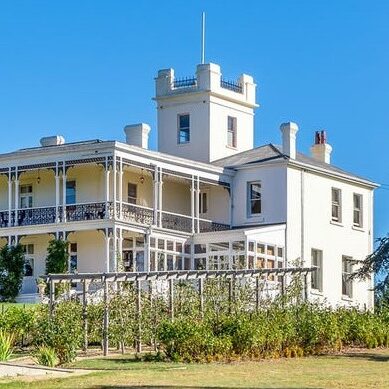
BERRIEDALE A Hobart City north suburb of 20-metres average elevation, is spread along the west bank of Derwent River, some 10-km north-west of Hobart City Post Office. It was named due to the inn established here in 1834 by Captain William Wilson (1782-1856) as a horse-changing station and refreshment rooms for weary travellers. He named the inn to honour the small village of Berriedale on Scotland’s north-east coast, and he is buried at Hestercombe Uniting Church Cemetery. The suburb is now home to Moorilla Winery (‘moorilla’ is local aboriginal for ‘rock by the water’), established by Cordio Alcorso (1930-2000) in 1958, and also MONA art gallery (‘Museum of Old and New Art’), established by canny betting man David Walsh in 2011, both properties now being owned by him. The estimated value of the MONA establishment today is approximately $80 million, and is a tourist ‘must see’. Population is approximately 2,700 folk.
FACTS ABOUT TASMANIA!
When your purchase is complete - you will be automatically redirected to the digital download page.